
Leave Your Message
-
Contact Phone
-
 Contact Email
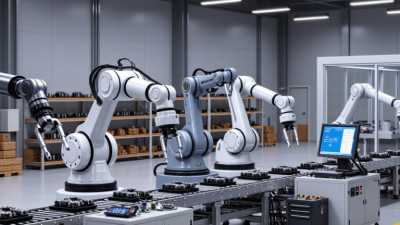
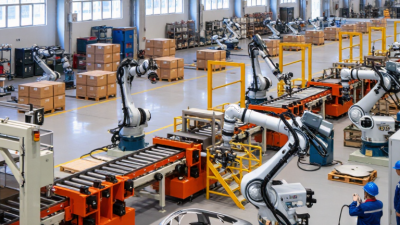
So, picking the right multi-axis robotic arm isn't just about comparing numbers like payload ratings – I mean, that's the obvious stuff. Honestly, it's about how the whole thing fits into your actual process, your workspace, the people who'll be operating it, and where you see production heading down the line. For instance, a six-axis arm can maneuver around fixtures without a hitch, but a four-axis model might be quicker in a simple pick-and-place setup. Honestly, the best choice? It boils down to movement, not the marketing fluff. That's really all there is to it.
So, here's the thing—you really need to start with the physical details. Like, actually measure the work envelope, figure out the mounting position, weigh the tool, check how the cables are routed, and locate the access points. That 10-kilo payload rating? Yeah, it might look good on paper, but once you add up the gripper, the camera, and the product itself, you could easily blow past it. And cycle time—don't just take their word for it. You've got to test it in practice. Then, when you're talking to suppliers, don't be shy about asking for repeatability data, programming support, what maintenance looks like, and whether they have documented safety functions. Now, the big names—FANUC, ABB, Yaskawa, KUKA—they each have their own vibe. Different ecosystems, different interfaces, and even their service models aren't the same. So yeah, it's not just about specs; it's about finding the one that fits how you actually work. Honestly, downtime is a killer—if you lose just one hour, it can wipe out an entire shift. And don't even get me started on the people working right next to the robot. They need clear controls, proper training, good guarding, and recovery procedures that actually make sense. A solid risk assessment should guide the whole cell design, and you better be hitting all the safety requirements. And here's the thing: a reliable supplier will tell you about the limitations, not promise perfect automation. That makes all the difference.
You know, in real factories, things rarely go exactly as planned. Products change, fixtures wear out, and budgets get tighter than you'd expect. So yeah, you've got to leave some wiggle room for revised tooling and software updates down the line. I've seen some pretty impressive robotic arms totally underperform just because the end effectors were a bad match. That's a real headache. This guide covers the practical stuff—what to look for, common mistakes to avoid, and the questions you should be asking before you hand over your money. And honestly, it's not about getting the flashiest, most advanced robot out there. What you really want is a dependable system that actually earns its keep on the production floor.
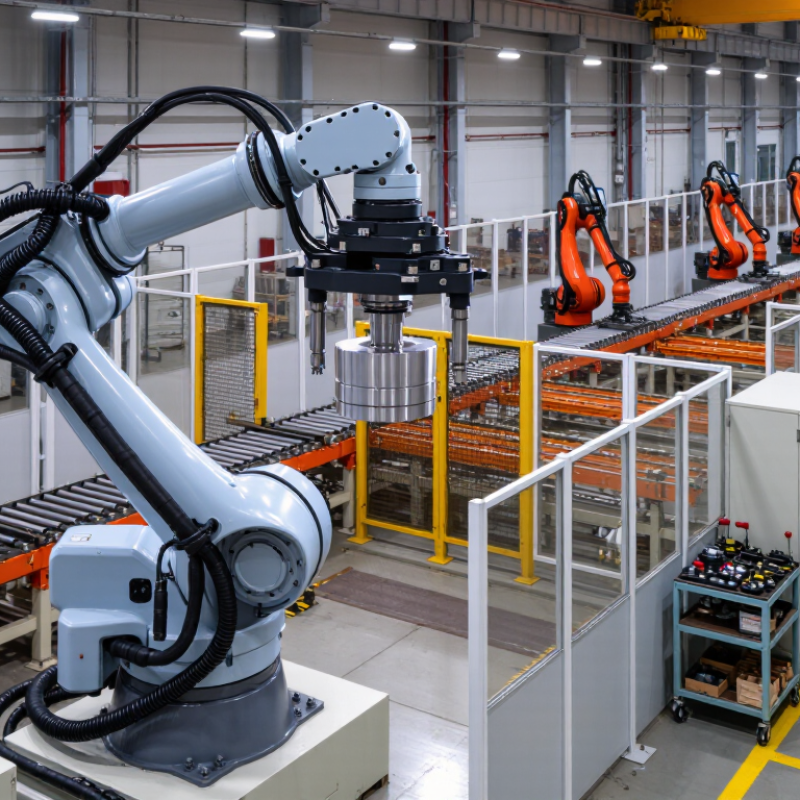
Choosing a multi-axis robotic arm starts with understanding its configuration, not its appearance. A three-axis arm handles simple pick-and-place paths. Four-axis models suit packaging and fast palletizing. Five- and six-axis arms provide better orientation control around angled surfaces. Seven-axis designs can reach behind fixtures and avoid obstacles more smoothly.
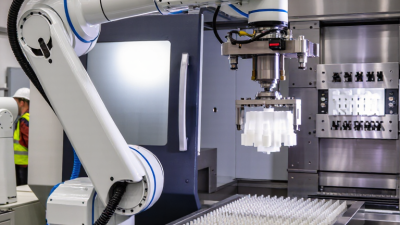
For Multi Axis Cnc Robotics, match the arm’s movement to the machine layout. Measure the work envelope, door clearance, payload, and required reach. A six-axis arm may rotate a tool precisely, but it can be unnecessary for flat loading tasks. Check repeatability under real loads, not only catalog conditions. During practical integration, cable routing and access for maintenance often receive too little attention. That mistake becomes expensive later. Configuration is never perfect.
Tips: Draw the workspace on paper first. Mark the spindle, fixture, operator zone, and emergency access. Test the heaviest tool with the shortest safe reach. Review wrist rotation limits before selecting a six-axis model. Keep the control system compatible with existing CNC signals and safety circuits. Ask for cycle-time data using your actual part weight and path. Small details matter.
| Robotic Arm Configuration | Typical Axes | Motion Arrangement | Typical Workspace | Typical Payload Range | Speed Capability | Positioning Performance | Key Advantages | Main Limitations | Common Applications | Best Selection Criteria |
|---|---|---|---|---|---|---|---|---|---|---|
| Cartesian / Gantry | 3–6 | Linear X, Y, and Z axes; optional rotary axes can be added at the wrist. | Rectangular or cubic working envelope; travel can be scaled over several meters. | About 1–2,000 kg, depending on rail design and structure. | Low to high; linear axes commonly provide approximately 0.1–5 m/s. | High repeatability; commonly around ±0.02–0.10 mm in well-engineered systems. | Rigid structure, simple programming, long reach, easy integration with conveyors and machine tools. | Large floor or overhead footprint; limited ability to work around obstacles unless rotary joints are added. | Machine tending, palletizing, large-part handling, dispensing, cutting, and 3D printing. | Choose when the process needs straight-line travel, a large rectangular workspace, or high structural rigidity. |
| SCARA | 4 | Two parallel rotary joints for horizontal motion, one vertical linear axis, and one rotary wrist axis. | Cylindrical or annular workspace, typically with a horizontal reach of approximately 400–1,000 mm. | About 1–20 kg. | Very high for planar assembly; some models achieve cycle times below 0.5 seconds for short moves. | High repeatability; commonly approximately ±0.01–0.05 mm. | Fast horizontal movement, compact footprint, good vertical compliance, and efficient assembly performance. | Limited orientation control and reduced ability to approach parts from complex angles. | Electronic assembly, pick-and-place, screwdriving, dispensing, packaging, and inspection. | Choose when speed, repeatability, and horizontal assembly operations are more important than full spatial dexterity. |
| Six-Axis Articulated | 6 | Six rotary joints that reproduce the movement of a shoulder, elbow, and wrist. | Approximately spherical or irregular workspace; reach commonly ranges from 0.5–3.2 m. | About 2–500 kg. | Medium to high; joint speed and payload strongly affect cycle time. | High flexibility; repeatability commonly ranges from approximately ±0.02–0.10 mm. | Full tool orientation, obstacle avoidance, flexible installation, and access to multiple sides of a workpiece. | Higher programming complexity, more singularity considerations, and greater maintenance requirements than simpler mechanisms. | Welding, painting, assembly, machine tending, material handling, polishing, and inspection. | Choose when the tool must approach parts from many angles or perform complex three-dimensional paths. |
| Delta / Parallel | 3–4 | Multiple lightweight parallel links move a platform; an optional fourth axis rotates the end effector. | Dome-shaped or approximately hemispherical workspace, generally optimized for a compact area below the robot. | About 0.1–15 kg. | Extremely high; suitable systems can perform well over 100 picks per minute under favorable conditions. | High repeatability; commonly around ±0.05–0.20 mm, depending on reach and load. | Very low moving mass, rapid pick-and-place cycles, and excellent hygienic accessibility in suitable designs. | Limited payload, restricted workspace, reduced performance near workspace boundaries, and sensitive load distribution. | Food handling, pharmaceutical packaging, sorting, small-part assembly, and high-speed product transfer. | Choose when cycle time is the priority and products are light, closely spaced, and presented on a conveyor. |
| Cylindrical | 3–4 | One rotary base axis combined with vertical and radial linear motion; an optional wrist axis provides rotation. | Cylindrical workspace surrounding the base, with useful vertical travel and radial reach. | About 5–100 kg. | Medium; well suited to repetitive handling within a defined cylindrical area. | Moderate to high; performance depends on the linear guides and rotary base. | Compact base, effective vertical access, and straightforward handling of parts around a central point. | Less flexible than six-axis systems and generally unable to provide complex tool orientations. | Machine loading, spot welding, die casting, material transfer, and basic assembly. | Choose when parts are arranged around a machine or cell and the process mainly requires radial and vertical movement. |
| Polar / Spherical | 3–4 | Rotary base and arm elevation combined with telescoping radial extension; an optional wrist axis may be included. | Spherical-sector workspace with broad angular access and variable radial reach. | About 10–250 kg. | Medium; generally slower than SCARA and delta systems for short repetitive cycles. | Moderate; accuracy varies significantly with arm extension and mechanical design. | Large reach from a compact base and useful access over or around fixtures. | More difficult kinematics, variable accuracy across the workspace, and lower orientation flexibility than six-axis arms. | Foundry handling, spray painting, casting, and applications requiring reach over obstacles. | Choose when broad radial reach is needed from a small mounting area and tool orientation demands are limited. |
| Seven-Axis Redundant | 7 | Six-axis articulated structure with an additional rotary joint, usually in the arm or elbow. | Similar to a six-axis arm but with improved posture choices and access around obstacles. | About 3–30 kg for many compact and collaborative-style systems. | Low to medium, depending on payload, safety limits, and the additional joint. | High; repeatability commonly falls in the approximately ±0.03–0.10 mm range. | Greater dexterity, improved singularity avoidance, flexible positioning, and easier access in confined cells. | Higher cost, more complex motion planning, and additional joint coordination requirements. | Complex assembly, trimming, inspection, close-quarters handling, and human-robot collaborative tasks. | Choose when the robot must work around fixtures, avoid obstacles, or maintain a preferred wrist orientation. |
| Collaborative Articulated | 6–7 | Articulated rotary joints with force and torque monitoring, speed limits, and safety-oriented control functions. | Approximately spherical or irregular workspace; common reach is about 0.5–1.8 m. | About 3–30 kg. | Low to medium because collaborative operating modes usually limit speed and force. | Moderate to high; typical repeatability is approximately ±0.02–0.10 mm. | Flexible deployment, simplified programming, compact footprint, and the potential to operate near people after a documented risk assessment. | Lower speed and payload than many conventional industrial robots; safety functions do not eliminate the need for guarding or risk assessment. | Light assembly, packaging, machine tending, quality checks, screwdriving, and laboratory automation. | Choose when quick redeployment, operator access, and flexible low-to-medium-load automation are priorities. |
| Important: The ranges shown are industry-typical guide values rather than guaranteed specifications. Actual reach, payload, cycle time, repeatability, safety requirements, and installation constraints must be verified against the selected robot, end effector, tooling, workpiece, and application risk assessment. | ||||||||||
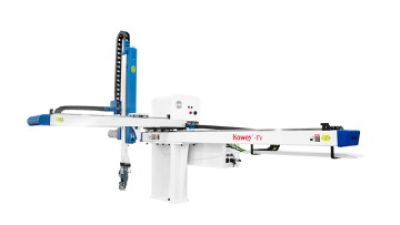
Television manufacturing increasingly depends on automated molding cells that can maintain consistent cycle times while handling a wide variety of plastic components. The International Federation of Robotics reported in *World Robotics 2023* that 553,052 industrial robots were installed worldwide in 2022, an annual increase of 5%. This growth reflects the industry’s shift toward programmable automation, especially where repeatability, labor efficiency, and stable production are essential. In this environment, the 3-Axis Full Servo Double-Stage Single-Arm Injection Robot---TV supports automatic part removal for injection molding machines from 100 to 650 tons, helping manufacturers standardize operations across different production lines.
Its three-axis servo drive enables precise, fast, and repeatable movements, while the double-stage single-arm structure balances high-speed picking with dependable operation. Flexible motion control allows the robot to adapt to different mold layouts and removal requirements, reducing manual handling and minimizing interruptions between molding cycles. The broad tonnage range also makes it suitable for producing television bezels, back covers, structural supports, and other standard injection-molded components. As manufacturing reports continue to emphasize the value of connected, flexible automation, one robot capable of serving multiple machine sizes can simplify equipment planning, improve line utilization, and support faster changeovers for varied television production schedules.
Start with the complete motion cycle, not a product catalog. Record pickup height, rotation angle, placement accuracy, and cycle time. Real tasks matter more.
Include the product, gripper, cables, and mounting hardware. Small omissions can overload the arm. Weights should be measured, not guessed.
Draw a simple floor plan with fixtures, guards, doors, conveyors, and operator paths. Check wrist angles, tool clearance, and maintenance access. Reach alone is insufficient.
Match the tool to the part’s surface, temperature, dust, and oil exposure. Soft parts may need vacuum cups. Hot parts require suitable materials and gripping force.
No. Six axes provide flexible wrist movement but can increase programming and maintenance effort. A simpler arm may deliver faster cycles for basic handling. I might still choose six axes too quickly.
Consider physical guarding, access detection, emergency stops, controlled stops, and restart prevention. Review pinch points and stopping distance. Do not rely on software limits alone.
Check electrical signals, communication methods, tooling, vision equipment, sensors, conveyors, and production software. Assign maintenance responsibility for every connection. Interfaces often look simple.
Measure actual cycles, payload, reach, accuracy, tooling, safety equipment, and integration labor. Record ten production cycles before deciding. Reserve space, power, sensors, and training capacity for future changes.
Choosing the right Multi Axis Robotic Arm begins with understanding the available configurations and how each one supports specific production tasks. Define the application clearly, including required movements, reach, payload, operating speed, positioning accuracy, and cycle time. These factors help determine whether the robot can handle the workload efficiently while maintaining consistent performance. It is also important to select suitable end-of-arm tooling and a control system that match the materials, processes, and level of automation required.
Before making a decision, evaluate the robot’s workspace, safety features, integration requirements, maintenance access, and operating environment. Consider how easily it can connect with existing equipment and whether operators can use and service it effectively. Finally, compare the total cost with current production goals and future expansion plans. A well-selected robot should provide practical value today while allowing flexibility for changing workloads, new applications, and long-term automation improvements.