
Leave Your Message
-
Contact Phone
-
 Contact Email
Looking into China's top 10 In-Mold Labeling Robot manufacturers gives us a pretty good idea of who’s driving automated packaging in the country. So, what exactly is an In-Mold Labeling Robot? Well, it’s a machine that places printed labels right inside an open mold before the plastic injection happens. This method helps create precise branding, cuts down on handling time, and reduces the need for extra labeling steps later on. But hey, even tiny errors matter — shifting a label by just a couple of millimeters can really affect how a product looks sitting on a retail shelf.
Now, when we evaluate these manufacturers, we try to stick to real-world factors rather than just fancy marketing claims. We look at things like how accurate they are when picking and placing labels, how steady their cycle times are, how well their servo controls work, compatibility with different molds, suitability for cleanroom environments, energy efficiency, and the level of tech support they provide. We also consider how easily their systems integrate with other machinery—think injection molding machines, vision inspection setups, label magazines, and take-out systems. John Beaumont, an expert in injection molding and author of The Moldflow Design Guide, always says, “The mold is the heart of the process,” and that still rings true here. Basically, a robot’s performance isn’t just about one shiny feature—it’s about how it fits into the entire molding cell.
Of course, no ranking can be perfect. Just because a factory is huge doesn’t mean it has the best automation, and cheaper systems might be just fine for simple containers. But if you’re dealing with complicated, thin-walled designs, you’ll need something more robust and precisely engineered. Plus, many brochures show ideal cycle times, but reality is messy: stuff like dust, temperature shifts, operator tweaks, and occasional misfeeds happen all the time. Those little details matter.
In this review, I’ll introduce you to ten Chinese manufacturers and compare their advertised capabilities with what buyers actually care about. We’ll separate marketing puffery from proven performance—looking at installation records, how quickly they respond to maintenance issues, how customizable their solutions really are, and whether these machines hold up over time. The goal isn’t to hype up every single supplier but to help you find the right In-Mold Labeling Robot that matches your product, mold, factory setup, and production goals.
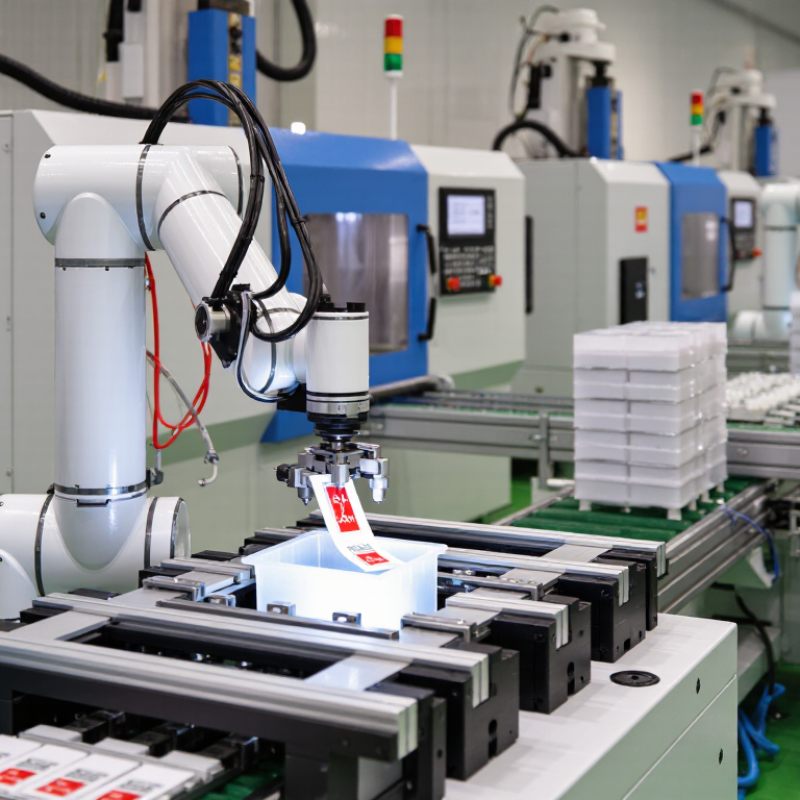
In-mold labeling places a printed label inside a mold before plastic injection begins. Heat and pressure bond the label to the container surface during molding. The result is a clean finish without a separate labeling station. The timing matters. A label may curl, shift, or wrinkle if temperature, air pressure, or placement is poorly controlled.
Robots support this process by picking labels, positioning them accurately, and removing finished parts. Their servo-driven arms can repeat the same motion through thousands of cycles. Vacuum grippers or mechanical fingers hold delicate labels during transfer. Vision systems may check orientation, surface defects, and label position before packaging. This helps manufacturers reduce manual handling and improve production consistency.
However, automation is not magic. A robot can repeat a bad setup with impressive accuracy. Experienced technicians still adjust gripper pressure, mold alignment, cycle speed, and label stiffness. Small errors matter. Dust on a mold surface can cause weak adhesion. Excessive speed can create vibration and misplacement. Reliable systems also record cycle data, allowing teams to trace faults and refine settings. In practical factories, the best results come from matching robot reach, payload, clean handling, and mold design rather than choosing speed alone.
The table below summarizes ten important, non-brand-specific capability areas used when evaluating in-mold labeling robot systems in China. The specifications represent common industry practices and typical application ranges rather than a ranking of individual companies.
| No. | Capability Dimension | Typical Industry Data | How the Robot Supports In-Mold Labeling | Practical Evaluation Criteria |
|---|---|---|---|---|
| 1 | Basic In-Mold Labeling Process | A printed label is placed inside an open mold before plastic injection. The label becomes integrated with the molded surface during the injection cycle. | The robot picks, transports, positions, and releases the label accurately before mold closing. | Check label placement accuracy, repeatability, mold compatibility, and synchronization with the injection molding machine. |
| 2 | Robot Configuration | Common systems use Cartesian or articulated robots. High-speed packaging applications frequently use servo-driven linear or multi-axis configurations. | Multiple servo axes coordinate label pickup, insertion, demolding, and part transfer within one automated cycle. | Evaluate axis count, motion range, payload, acceleration, repeatability, and available installation space. |
| 3 | Label Material Compatibility | Typical label substrates include polypropylene (PP), polyethylene (PE), polyester (PET), paper, and specially coated films, depending on the product and molding process. | Vacuum cups, grippers, static-electricity control, and label magazines are selected according to label stiffness, surface finish, and thickness. | Confirm compatibility with label thickness, curl, moisture sensitivity, surface coating, and electrostatic behavior. |
| 4 | Placement Accuracy | Modern servo handling systems are commonly designed for sub-millimeter positioning repeatability, although the actual result depends on the mold, label, gripper, and machine setup. | Closed-loop servo control and programmed motion paths help align graphics, windows, seams, and container features. | Request measured repeatability under production conditions rather than relying only on nominal controller resolution. |
| 5 | Cycle-Time Coordination | Production cycle time is determined by the injection machine, mold cooling requirements, label handling, product geometry, and quality inspection. High-speed packaging lines may operate at several cycles per minute. | The robot performs label insertion and part removal in parallel where the mold and safety system allow it, reducing non-productive time. | Compare complete cycle time, robot entry and exit time, label loading time, and recovery time after a fault. |
| 6 | Label Feeding and Separation | Automatic systems generally use a magazine, stack feeder, conveyor, or roll-fed label unit. Reliable separation is essential for preventing double picks. | Vacuum sensing, mechanical separation, vision checks, and missing-label detection help maintain continuous operation. | Assess magazine capacity, refill method, double-sheet detection, label changeover time, and reject handling. |
| 7 | Vision and Quality Inspection | Camera inspection can verify label presence, orientation, position, print registration, surface defects, and product completeness. | The robot controller or production line PLC can use inspection signals to stop, reject, or rework nonconforming parts. | Review camera resolution, lighting control, inspection speed, traceability functions, and false-rejection performance. |
| 8 | Machine and Mold Integration | Robotic IML cells normally communicate with the injection molding machine, mold sensors, safety circuit, label feeder, and downstream conveyor. | Digital I/O, industrial communication interfaces, mold-position signals, and safety interlocks coordinate the complete sequence. | Verify interface compatibility, signal lists, safety category, mold-change procedure, and commissioning support. |
| 9 | Cleanliness and Production Environment | Packaging, food-contact, medical, and clean manufacturing applications require suitable materials, hygienic design, controlled lubrication, and contamination management. | Low-particle grippers, smooth surfaces, controlled air supply, and enclosed or protected mechanisms help reduce contamination risks. | Check stainless-steel or corrosion-resistant components, cleanability, compressed-air quality, and applicable customer or regulatory requirements. |
| 10 | Changeover, Maintenance, and Safety | Changeover requirements vary with container shape, label size, mold design, and product family. Safety guarding and interlocks are standard requirements for automated cells. | Recipe management, quick-change tooling, automatic parameter storage, diagnostics, and safe access reduce downtime and operator risk. | Evaluate tooling exchange time, spare-parts availability, alarm records, operator training, guarding, emergency stops, and risk assessment documentation. |
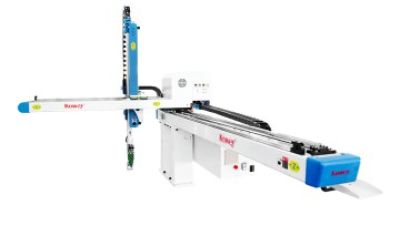
A light 3-axis pick and place injection robot offers a practical way to improve efficiency in small- and medium-sized injection molding workshops. Designed for injection molding machines from 50 to 450 tons, it uses a full-servo drive system and a two-stage telescopic single-arm structure. This compact design saves floor space while providing stable, accurate movement for removing molded parts and sprues.
Before installation, confirm the machine tonnage, mold layout, product dimensions, and required take-out position. The robot can be configured for several common tasks, including part picking, blanking, stacking, and material handling. Its lightweight structure supports quick movement and helps reduce manual intervention, making it suitable for standard plastic products, precision small components, and housing-type parts. Operators should also set the gripping position, travel distance, and placement sequence according to the production cycle.
For mass production, consistent robotic handling can reduce errors caused by fatigue and improve workplace organization. The three-axis system enables smooth coordination between horizontal, vertical, and extraction movements, while the telescopic arm supports flexible access to different mold configurations. With proper programming and routine maintenance, this equipment can replace repetitive manual removal work and support a more reliable, efficient, and scalable automation process.
It picks one printed label from a stack or roll using vacuum cups or electrostatic hold. Then it places the label inside the open mold. Small target.
The mold closes, and molten plastic flows behind the label. Heat and pressure bond it to the container as the part forms.
A shift of just a few millimeters can create wrinkles or poor alignment. Sensors and programmed coordinates help, but setup still needs careful testing.
Static electricity, humidity, and curled labels can cause feeding problems. A dropped label may also stop the cycle. Not always easy to fix.
Compare robot reach, cycle-time data, label handling, and machine compatibility. Use the same sample container and production targets for each supplier.
Modular grippers can support several shapes and may make changeovers faster. Ask how adjustments work on the actual line; brochures can miss small access problems.
No. Simulations can check reach, timing, and collision risks, but factory conditions may differ. Mold temperature, label stiffness, and operator habits all matter.
Check installation, operator training, spare parts, and who manages integration between the robot and molding machine. A small support gap can cause real downtime.
Run realistic production trials and inspect alignment, wrinkles, changeovers, and recovery from misfeeds. A fast quoted cycle time may not fit every plant.
This article explores how In-Mold Labeling works and how an In-Mold Labeling Robot places labels inside a mold during the molding process, helping combine labeling and production in one efficient operation. It explains the robot’s basic workflow, including how it handles labels, coordinates with molding equipment, and supports consistent placement, reliable cycle times, and reduced manual handling.
The article also presents key criteria for evaluating manufacturers, such as technical capabilities, customization, production support, quality control, and service. It offers an overview of ten manufacturers and profiles leading providers without focusing on brand promotion. Finally, it considers common applications and emerging developments in in-mold labeling robotics, including greater automation, improved precision, and integration with modern production systems.